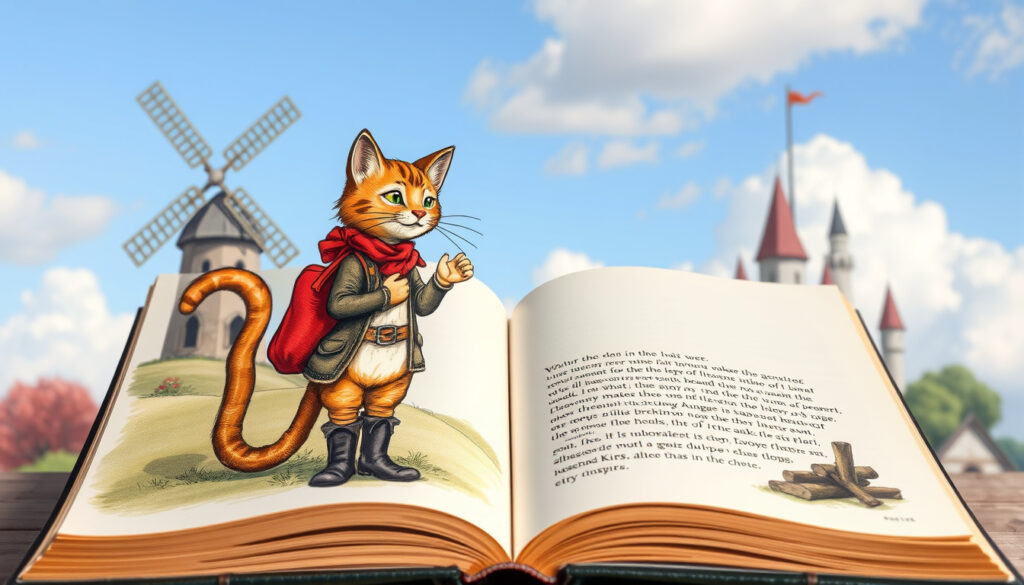
Puss in Boots: Origin, Breed, and Moral Lesson
Few fairy-tale characters have crossed centuries and screens quite like Puss in Boots—a swashbuckling cat whose boots have carried him from 1697 French pages to the anxiety-filled world of DreamWorks animation; this guide separates the literary history from the fan theories. One thing is certain: the character’s journey from trickster to vulnerable hero is as layered as his orange fur.
First appearance: 1697 (Perrault fairy tale) ·
Voice actor: Antonio Banderas (2004–present) ·
Fictional breed association: British Shorthair ·
First film: Shrek 2 (2004)
Quick snapshot
- First published in 1697 by Charles Perrault (Wikipedia (folkloric reference))
- French title: Le Chat Botté (Wikipedia (folkloric reference))
- Anthropomorphic cat with magical boots (Wikipedia (folkloric reference))
- Shrek 2 (2004) – first film appearance (Wikipedia (DreamWorks character profile))
- Puss in Boots (2011) – solo feature film (Wikipedia (DreamWorks character profile))
- Puss in Boots: The Last Wish (2022) – sequel (Wikipedia (DreamWorks character profile))
- Voiced by Antonio Banderas across all films (Wikipedia (DreamWorks character profile))
- The booted appearance became a defining visual identity (The Independent (cultural commentary))
- Breakout character from the Shrek franchise (Wikipedia (DreamWorks character profile))
- Trickery and wit over strength (American Literature (public-domain text))
- Social mobility and ambition (American Literature (public-domain text))
- Mortality and loss of lives (Wikipedia (DreamWorks character profile))
Six key facts about the character, from his literary debut to his on-screen persona:
| Attribute | Value | Source |
|---|---|---|
| First appearance in print | 1697, by Charles Perrault | Wikipedia (folkloric reference) |
| First film appearance | 2004, Shrek 2 | Wikipedia (DreamWorks character profile) |
| Voice actor | Antonio Banderas (2004–present) | Wikipedia (DreamWorks character profile) |
| Notable character trait | Wears boots, carries a sword, uses charm and guile | Wikipedia (folkloric reference) |
| Lives in The Last Wish | 1 (started with 9) | Wikipedia (DreamWorks character profile) |
| Breed description (film) | Orange tabby, possibly British Shorthair or domestic longhair mix | Purina (cat breed authority) / A-Z Animals (animal fact site) |
What is Puss in Boots meant to be?
- Puss in Boots is a fairy tale character from Charles Perrault’s 1697 collection Histoires ou contes du temps passé (Wikipedia (folkloric reference)).
- The character is an anthropomorphic cat who uses trickery and wit to gain wealth and status for his master (Wikipedia (folkloric reference)).
- In the Shrek film universe, Puss is a swashbuckling outlaw and former bounty hunter (Wikipedia (DreamWorks character profile)).
At its simplest, Perrault’s creation is a trickster archetype wrapped in fur and leather. Modern interpretations add layers of charm and vulnerability, but the original tales frame him as a clever opportunist who bends reality through sheer deception. The implication: Puss in Boots serves as a symbol of wit triumphing over brute force, a theme that remains central across all adaptations.
What is the true story of Puss in Boots?
- The original 1697 tale by Charles Perrault has no known single “true” historical basis; it is a literary fairy tale (Wikipedia (folkloric reference)).
- Some analysts note similarities to earlier Italian folk tales, like Straparola’s Constantino Fortunato (1550s) (FirstCry (children’s educational site)).
- The story was moralistic: praising cunning and social climbing over honesty and hard work (as Perrault’s morals state) (American Literature (public-domain text)).
There is no hidden chronicle behind the boots. The tale is a constructed fiction that likely drew on oral traditions. The pattern: Perrault repackaged folk motifs into a polished narrative that celebrated upward mobility—a controversial moral even in its own time. What this means is that any “true story” claims are modern myths; the character’s power lies in his fictional ambiguity.
Why is he called Puss in Boots?
- The name “Puss” is an archaic English term for a cat (Wikipedia (folkloric reference)).
- In the original French, the character is Le Chat Botté (The Booted Cat) (Wikipedia (folkloric reference)).
- The boots are the key item that distinguishes the character, a gift from his master that allows him to walk upright and perform his trickery (The Independent (cultural commentary)).
The boots are not just a fashion statement—they are the engine of the plot. Without them, the cat is just another animal; with them, he becomes a gentleman trickster. The trade-off: the boots give him agency but also tie his identity to a single prop, making the character instantly recognizable across centuries.
The boots anchor Puss in the human world. They transform a domestic pet into a social climber, a distinction that Perrault explicitly praises in his second moral: “Fine clothes and a good appearance can win admiration.”
The inference: the boots are the defining feature that enables his trickery and social ascent.
What breed is Puss in Boots?
- In the Shrek films, Puss in Boots is an orange tabby cat. Purina identifies him as one of the most famous fictional British Shorthairs (Purina (cat breed authority)).
- However, the breed is not officially confirmed; he resembles a domestic longhair or a Cymric (longhaired Manx) (A-Z Animals (animal fact site)).
- Animator Tom Hester designed the character based on real cats, but no specific breed was declared (Wikipedia (DreamWorks character profile)).
The debate over his breed is a classic case of fan speculation meeting limited official data. The pattern: Purina (a cat food company) claims him as a British Shorthair, while DreamWorks has never issued a definitive breed. The catch is that his design prioritises animation appeal over feline accuracy—his big eyes and expressive face are stylised, not breed-specific. For information on real animal breeds, see our guide on the Toy Poodle.
What is the moral lesson of Puss in Boots?
- Perrault’s first moral: knowledge and industry can be more valuable than inherited status (American Literature (public-domain text)).
- His second moral: fine clothes and a good appearance help win admiration (American Literature (public-domain text)).
- Modern children’s retellings often highlight courage, clever thinking, and loyal friendship (Kooky Kids World (children’s storytelling site)).
There is no single unanimous moral. The original tale celebrates cunning and appearance; modern adaptations sand down the edges to fit contemporary values. The implication: the character’s moral flexibility is what has kept him relevant for over 300 years—each generation finds its own lesson in his boots.
The takeaway: these two moral frameworks coexist, and the choice between them shapes the story’s impact on audiences.
What disorder does Puss in Boots have?
- In Puss in Boots: The Last Wish, Puss exhibits symptoms of anxiety and possible post-traumatic stress after losing eight of his nine lives (Wikipedia (DreamWorks character profile)).
- The film directly shows panic attacks, hypervigilance, and fear of death (Wikipedia (DreamWorks character profile)).
- No official clinical diagnosis is stated, but the portrayal is consistent with severe anxiety disorder (A-Z Animals (animal fact site)).
The pattern: DreamWorks deliberately included mental‑health themes without labeling them, allowing the character’s vulnerability to resonate with audiences. The catch: viewers should interpret the depiction as a narrative device rather than a clinical case study.
What is the darkest fairy tale ever written?
- Many dark fairy tales exist, e.g., The Juniper Tree (Grimm) involving murder and cannibalism (Wikipedia (folkloric reference)).
- No single authoritative ranking exists; it is subjective.
- Puss in Boots is generally not considered a particularly dark tale — it leans comic/clever (Wikipedia (folkloric reference)).
The conclusion: while Perrault’s story contains cynical morals, it lacks the graphic violence of other folk tales. The implication: “darkness” in fairy tales is a matter of tone and intent, not just content.
Timeline of Puss in Boots
- 1697 – Charles Perrault publishes Le Chat Botté in France (Wikipedia (folkloric reference)).
- 2004 – Puss in Boots first appears in Shrek 2, voiced by Antonio Banderas (Wikipedia (DreamWorks character profile)).
- 2011 – Solo film Puss in Boots released (Wikipedia (DreamWorks character profile)).
- 2022 – Sequel Puss in Boots: The Last Wish released (Wikipedia (DreamWorks character profile)).
The timeline shows a gap of more than 300 years between literary birth and cinematic debut, underscoring the character’s enduring appeal.
Confirmed facts vs. What’s unclear
Confirmed facts
- Puss in Boots is a fairy tale character created by Charles Perrault (Wikipedia (folkloric reference)).
- The character first appeared in the Shrek franchise in 2004 (Wikipedia (DreamWorks character profile)).
- Antonio Banderas voices Puss in Boots across all DreamWorks films (Wikipedia (DreamWorks character profile)).
What’s unclear
- Whether Puss in Boots has a specific confirmed breed (no official designation) (A-Z Animals (animal fact site)).
- The exact medical disorder Puss in Boots has: only anxiety depicted, no clinical diagnosis given (Wikipedia (DreamWorks character profile)).
- The “true story” behind the fairy tale – no single historical event is proven (Wikipedia (folkloric reference)).
The interplay between confirmed facts and lingering questions is what keeps fan discussion alive.
Quotes from key voices
“The moral of the tale is that knowledge and industry can be more valuable than inherited status.”
— Charles Perrault, from the original 1697 story (American Literature (public-domain text))
“Puss in Boots is one of the most famous fictional British Shorthairs.”
— Purina (Purina (cat breed authority))
The gap between these two sources highlights the character’s dual life: a literary trickster on one side, a pop-culture icon on the other. For more on fictional characters, see our profile of Thomas Shelby from Peaky Blinders.
For fans of the Shrek franchise, the implication is clear: the character’s journey from trickster to vulnerable hero mirrors a broader cultural shift towards addressing mental health in animated films. Understanding his origins only deepens the appreciation of his latest adventure. For parents introducing the story to children, the choice between the cynical Perrault original and the kinder film version will shape the lesson learned.
firstcry.com, kookykidsworld.com, catsforlife.co, youtube.com, scribd.com, reddit.com, lovethynerd.com
The character’s evolution from a 1697 trickster to an anxious hero is explored in the 2022 film The Last Wish, which delves into the film’s critical and commercial success.
Frequently asked questions
What does Puss in Boots represent in the fairy tale?
He represents wit, cunning, and social ambition—the power of appearance and intelligence over inherited wealth.
How many Puss in Boots movies are there?
There are two solo films (Puss in Boots in 2011 and The Last Wish in 2022) plus appearances in Shrek 2, Shrek the Third, and Shrek Forever After.
Is Puss in Boots based on a real cat?
No, the character is a fictional creation by Charles Perrault. A real British Shorthair named Pisco gained attention for resembling the animated cat, but Puss is not based on any specific real animal. For more on animal breeds, see our guide on the Toy Poodle.
What is the significance of the boots in the story?
The boots allow the cat to walk upright, trick humans, and impersonate a nobleman—they are the tool that enables his entire scheme.
Does Puss in Boots die in The Last Wish?
No, he survives. The film deals with his fear of death after losing eight lives, but he ultimately chooses to value the life he has left.
What animated series features Puss in Boots?
After the 2011 film, a spin-off series The Adventures of Puss in Boots aired on Netflix from 2015 to 2018.
How does Puss in Boots compare to the original fairy tale?
The film version adds a backstory, romance, and action-adventure elements, while the original tale is a simpler, more cynical story about deception and social climbing.
More related posts
 Ibrahim Traoré: Biography, Religion, Burkina Faso Crisis
 Canada Winter Weather Warnings: Types, Map & Coldest Cities
 Super Visa Insurance 2026: Requirements, Costs & Coverage
 Jonathan Taylor Thomas: What Happened, Net Worth & Tim Allen
 Lindsey Buckingham: Stevie Nicks Relationship, Firing & Health
 Still Wakes the Deep – Review and Ending Explained
 Pink Floyd Members Alive, Richest, and Biggest Hit Song
 Area of a Trapezoid: Formula, Examples & Calculation
