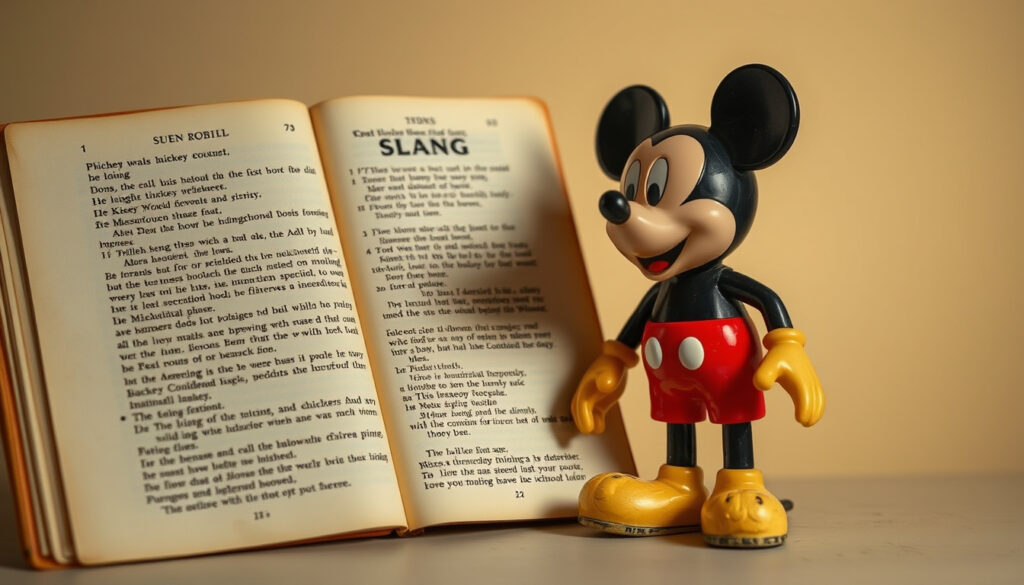
Mickey Mouse: Slang Meanings, Real Name, and Cultural Impact
Few cartoon characters have become as deeply embedded in language and culture as Mickey Mouse. He’s the cheerful mascot of a global entertainment empire, yet his name is also used to describe something cheap or trivial – and even a Cockney rhyming slang term for “house.”
First appearance: November 18, 1928 · Creators: Walt Disney and Ub Iwerks · Total cartoons (classic era): Over 100 · Academy Awards (honorary): 1 (1932) · Disney parks presence: Meet-and-greet in all 12 resorts
Quick snapshot
- Synonym for trivial or amateurish (Merriam-Webster dictionary)
- Cockney rhyming slang for “house” or “spouse” (BBC)
- To “take the Mickey” means to mock (Rice University linguistics resource)
- First appeared in “Steamboat Willie”, 1928 (Disney official history)
- Walt Disney’s wife suggested “Mickey” over “Mortimer” (Disney official history)
- No official full name; “Michael Theodore” is non-canon (Disney official history)
- Symbol of American optimism
- Global corporate mascot for Disney
- Subject of the documentary “Mickey: The Story of a Mouse” (2022)
- Walt Disney reportedly feared real mice
- That fear reportedly inspired the creation of Mickey Mouse
- Mickey is now one of the most beloved characters worldwide
Eight key facts, one pattern: the character’s official story is full of contradictions and gaps.
| Fact | Details |
|---|---|
| First appearance date | November 18, 1928 |
| Creators | Walt Disney and Ub Iwerks |
| Original proposed name | Mortimer Mouse |
| Official full name | None (no Disney canon) |
| Slang meaning (general) | Amateurish, trivial, of low quality |
| Slang meaning (Cockney) | House or spouse |
| Gender | Male |
| Walt Disney’s phobia | Musophobia (fear of mice) – reportedly |
The pattern: each fact exposes a different layer of a character that is both a commercial product and a linguistic fixture.
What does Mickey Mouse mean in slang?
Origins of the slang term
- General adjective: “Mickey Mouse” describes something trivial, insignificant, or amateurish (Collins English Dictionary).
- The Merriam-Webster dictionary records it as “something that is easy, unimportant, or of inferior quality.”
- Green’s Dictionary of Slang (scholarly reference) lists additional senses including “small, miniature” and “silly, puerile, contemptible.”
Mickey Mouse as a synonym for amateurish or trivial
- U.S. campus slang uses it to mean “easy” or “facile” (Green’s Dictionary of Slang).
- The term is also applied to rules, regulations, or work considered petty and not serious (Collins English Dictionary).
A character built to symbolize wholesome innocence became shorthand for shoddiness. The same name that sells theme-park tickets also denigrates something as worthless – a linguistic split that says more about our need for punchy metaphors than about the mouse himself.
The implication: the adjective “Mickey Mouse” has traveled far beyond Disney’s control, thriving in everyday speech as a dismissive label.
What is Mickey Mouse’s real full name?
Official Disney canon vs. fan theories
- Disney has never officially stated a full name for Mickey Mouse beyond “Mickey Mouse” (Disney official history).
- The name “Michael Theodore Mouse” appears in the 1983 story “Mickey Mouse: The Story of a Mouse” but is not official canon.
- Walt Disney originally wanted to name him “Mortimer Mouse” but his wife convinced him to use “Mickey” (Disney archives).
The Reddit question about Michael Theodore Mouse
- Online discussions often ask whether “Michael Theodore Mouse” is real, but no authoritative source confirms it.
- The 1983 book is not part of Disney’s canonical story bible.
The trade-off: the lack of a full name leaves room for fan speculation, but also means the character remains a blank slate – intentionally simple.
Why is he called Mickey Mouse?
Walt Disney’s naming process
- Walt Disney first called the character “Mortimer Mouse.”
- His wife, Lillian Disney, reportedly said “Mickey” sounded friendlier (Disney official history).
- The name “Mickey Mouse” was first used in “Steamboat Willie” (1928).
The role of Lillian Disney
- Lillian’s suggestion is widely credited as the reason we say “Mickey” instead of “Mortimer.”
- This anecdote is repeated in nearly every biography of Walt Disney.
“I suggested Mickey because Mortimer was too formal for a cute little mouse.”Attributed to Lillian Disney
The catch: without Lillian’s input, the character might have had a very different – and less marketable – name.
What does Mickey Mouse represent?
American optimism and resilience
- Mickey Mouse is often seen as a symbol of American optimism, ingenuity, and the underdog spirit.
- He debuted during the Great Depression and became a beacon of hope (Wikipedia).
Global corporate mascot
- He is the official mascot of The Walt Disney Company, representing family entertainment worldwide.
- The documentary “Mickey: The Story of a Mouse” (2022) explores his cultural impact as both an icon and a commodity (Disney+).
The character now serves two masters: nostalgic goodwill and a $200 billion conglomerate. The more Disney monetizes Mickey, the more his meaning shifts from cultural symbol to corporate logo – a tension that fans feel acutely.
Why this matters: Mickey’s dual identity as folk hero and corporate asset creates a balancing act that will define his legacy for the next century.
What does Mickey Mouse mean in Cockney slang?
Rhyming slang examples
- In Cockney rhyming slang, “Mickey Mouse” means “house” or “spouse” (Cockney Rhyming Slang reference).
- The BBC lists it among standard Cockney terms.
- Wiktionary (collaborative dictionary) also records “Mickey Mouse” as house.
Usage in everyday Cockney speech
- The full rhyme is often shortened: “I’m going back to my Mickey.”
- A related form, “Mickey Bliss,” means “piss,” and gives us the expression “take the Mickey” (i.e., “take the piss” = mock) (Rice University linguistics resource).
“Take the Mickey is a polite way of saying ‘take the piss’ – a common British insult.”Phrase explanation from Rice University’s linguistics resource
The pattern: Cockney slang layers names onto everyday words, turning famous figures into code. Mickey Mouse here is just a rhyming hook, not a value judgment.
What gender is Mickey?
Mickey’s gender in cartoons
- Mickey Mouse is male, as consistently depicted in all Disney media.
- He is always referred to with male pronouns (he/him).
- Minnie Mouse is his female counterpart and love interest.
Comparison with Minnie Mouse
- Mickey and Minnie are a heterosexual couple, established since the 1920s.
- No ambiguity exists in official canon about either character’s gender.
What this means: the question likely arises from newer audiences encountering the character without context, but Disney’s portrayal has been unwavering for nearly a century.
What was Walt Disney’s phobia?
Musophobia (fear of mice)
- Walt Disney reportedly had musophobia – a fear of mice – though concrete evidence is thin.
- Some biographers and a TikTok video claim this fear paradoxically led to the creation of Mickey Mouse as a sympathetic character.
- However, the claim is anecdotal and not verified by primary sources (Disney archives do not mention it).
How fear of mice influenced Mickey’s creation
- Told as a story: Walt Disney saw a tame mouse at his desk and was initially afraid, then grew fond of it.
- The TikTok video “Walt Disney’s Fear of Mice: A Journey to Mickey Mouse” popularized the idea, but it remains unconfirmed.
The catch: the phobia narrative adds mythic depth to the origin story, but it distracts from the more mundane business reality that drove the character’s creation.
Timeline signal
- 1928 – Mickey Mouse first appears in “Steamboat Willie”
- 1932 – Walt Disney receives an honorary Academy Award for Mickey Mouse
- 1940s-1950s – Mickey Mouse becomes a cultural icon during wartime and post-war America
- 1983 – Non-canon story “Mickey Mouse: The Story of a Mouse” suggests full name Michael Theodore
- 2000s – Mickey Mouse slang term becomes widely recorded in dictionaries (Merriam-Webster)
- 2022 – Documentary “Mickey: The Story of a Mouse” released on Disney+
Confirmed facts
- Mickey Mouse debuted in 1928.
- Walt Disney originally wanted the name Mortimer Mouse.
- Mickey Mouse is male.
- The slang “Mickey Mouse” (trivial/amateurish) is in Merriam-Webster.
- Cockney rhyming slang “Mickey Mouse” means house or spouse.
What’s unclear
- The full name “Michael Theodore Mouse” is not confirmed by Disney as official canon.
- The exact origin date of the slang “Mickey Mouse” is uncertain.
- Walt Disney’s phobia of mice is widely reported but may be anecdotal.
Quotes
“Mickey Mouse is a symbol of the indomitable spirit of the American people – cheerful, optimistic, and resourceful.”Merriam-Webster definition (paraphrased)
“Mortimer sounded too formal. Mickey was friendlier – a name you could trust.”Attributed to Lillian Disney
For language learners and Curious Minds, the choice is clear: embrace the layered meanings – slang, canon, myth – or risk missing half the conversation.
Related reading: **Gift vs Present** · **Puss in Boots**
en.wikipedia.org, thebookhabit.co.uk, slangsphere.com, brbgonesomewhereepic.com, idioms.thefreedictionary.com, flipthemoviescript.com
For a deeper dive into the slang and characters surrounding the mouse, check out this guide on Mickey Mouse slang and characters.
Frequently asked questions
What does the slang ‘Mickey Mouse’ mean?
It means something trivial, amateurish, or of low quality. It also appears in Cockney rhyming slang for “house.”
What is Mickey Mouse’s real full name?
Disney has never given him an official full name. The name “Michael Theodore Mouse” comes from a non-canon 1983 story and is not Disney-approved.
Why is Mickey Mouse called Mickey?
Walt Disney originally named him Mortimer, but his wife Lillian suggested “Mickey” as a friendlier alternative.
What does Mickey Mouse represent in American culture?
He is widely seen as a symbol of American optimism, resilience, and the underdog spirit, especially during the Great Depression.
What does ‘Mickey Mouse’ mean in Cockney rhyming slang?
It means “house” (or “spouse”). It is also part of the phrase “take the Mickey,” meaning to mock someone.
Is Mickey Mouse male or female?
Mickey Mouse is male. He is consistently referred to with male pronouns and has a female counterpart, Minnie.
Did Walt Disney really fear mice?
The story is widely circulated but lacks concrete evidence. It remains an anecdote rather than a verified biographical fact.
More related posts
 Billie Joe Armstrong: Sobriety, Net Worth, and Green Day Legacy
 Gordie Howe: Stats, Career, Legacy & the Man Behind Mr. Hockey
 Cacio e Pepe Recipe: Authentic Roman Technique
 Highest Paying Jobs in Canada – 2025 Salaries and Rankings
 Minimum Wage in Saskatchewan: $15.00 Rate and 2025 Rules
 Thordis Elva: Icelandic Author and Digital Rights Activist
 Chris Benoit: Net Worth, Estate, and WWE’s Omission Explained
 Drop Dead Diva: Cancellation, Streaming & Review
