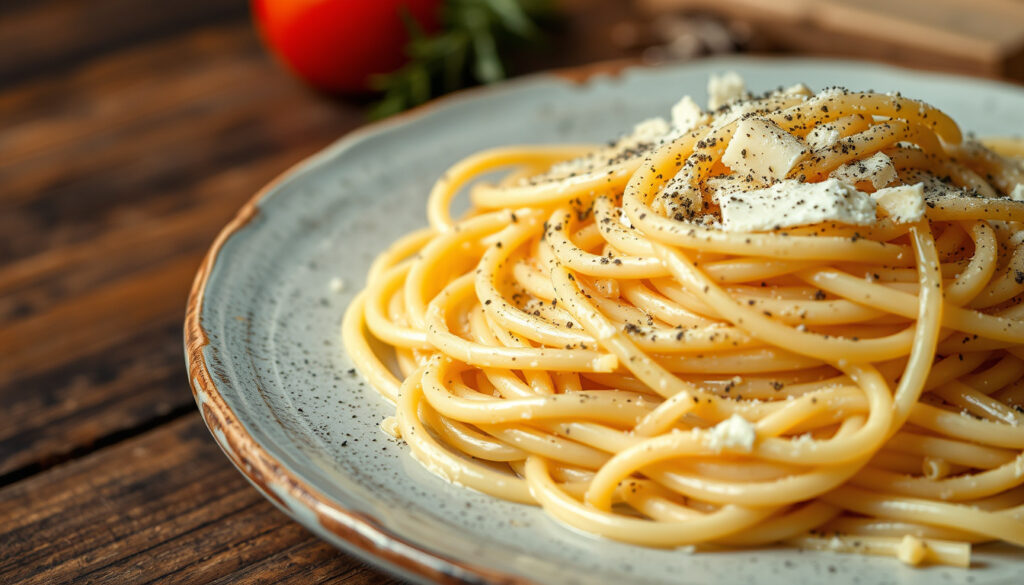
Cacio e Pepe Recipe: Authentic Roman Technique
Few pasta dishes demand so little yet reward so much as cacio e pepe. Four ingredients — pasta, Pecorino Romano, black pepper, pasta water — and the whole thing hinges on one technique most home cooks get wrong on their first try. The sauce splits, clumps, or turns gummy. But once you understand why the emulsion matters, the dish transforms from frustrating to foolproof.
Key Ingredients: 4 (spaghetti, pecorino romano, black pepper, pasta water) · Prep Time: 15 minutes · Servings: 2-4 · Origin: Roman Italy · Calories per Serving: 500-600
Quick snapshot
The overview below consolidates what sources confirm, what remains uncertain, and what home cooks can expect next.
- 3 core ingredients fixed: cheese, pepper, pasta (Wikipedia)
- No cream or garlic in authentic version (Honest Cooking)
- Origins trace to shepherds in 18th-19th century Lazio (Wikipedia)
- Black pepper added later due to expense and scarcity (Wikipedia)
- Recipe works best with young Pecorino Romano DOP for smooth melting (Chef Bike Ski)
- Technique mastery unlocks Roman pasta “holy trinity” variations (Chef Bike Ski)
The key facts below summarize the essential parameters for executing cacio e pepe correctly.
| Attribute | Value |
|---|---|
| Origin | Rome, Lazio, Italy |
| Main Pasta | Spaghetti or tonnarelli |
| Cheese | Pecorino Romano |
| Difficulty | Intermediate |
| Key Technique | Pasta water emulsion |
What ingredients are in cacio e pepe?
The beauty of cacio e pepe lies in its restraint. With only three core ingredients — plus pasta water as the binder — this Roman classic proves that complexity lives in technique, not ingredient count (Wikipedia).
Core ingredients
- Spaghetti or tonnarelli — Traditional Roman shapes, not egg-based fresh pasta. Tonnarelli resembles thick spaghetti with a slightly squared edge (Inside The Rustic Kitchen). Bucatini works as a substitute in some authentic recipes (Christina’s Cucina).
- Pecorino Romano DOP — A hard sheep’s milk cheese aged 8-12 months. The name “cacio” derives from this cheese specifically. Avoid overly aged varieties: they clump instead of melt smoothly. Younger Pecorino (around 5 months) works better for the emulsion (Chef Bike Ski).
- Black pepper — Must be freshly ground and abundant. Toast whole peppercorns in a dry or lightly oiled pan for 1-2 minutes before grinding to unlock aromatic oils (Honest Cooking).
- Pasta water — The secret weapon. Starchy, sodium-rich water acts as an emulsifier, binding cheese proteins to create a creamy sauce without cream or butter (Gourmet Project).
Substitutions to avoid
Pecorino Romano is 3x more flavorful than Parmigiano Reggiano for this dish, according to Chef Bike Ski (food writer). Substituting Parmesan changes the character fundamentally. Garlic, cream, butter, or oil have no place in authentic cacio e pepe.
What’s the secret to perfect cacio e pepe?
The secret is the creamy sauce, obtained by combining best quality Pecorino Romano and a few spoons of the water used to cook the pasta (Honest Cooking (food blog covering Roman culinary traditions)). This isn’t magic — it’s chemistry applied with timing.
Pasta water emulsion
Cheese proteins clump when heated too fast or exposed to dry conditions. The solution: starchy water creates a protective starch matrix around protein strands, allowing them to stay suspended (Gourmet Project (detailed recipe resource)).
- Reserve 1-2 cups of water before draining pasta
- Add cheese mixture off heat entirely
- Add water incrementally — start with 2-3 tablespoons
- Toss vigorously while adding water to encourage smooth integration
Freshly ground pepper
Pre-ground pepper fades fast. Toast whole peppercorns in a skillet for 1-2 minutes until fragrant, then grind coarsely. Roman recipes call for generous amounts — this dish is named for both the cheese (“cacio”) and pepper (“pepe”) (Honest Cooking).
Cheese grating method
- Grate Pecorino Romano on the finest holes of a box grater
- Room temperature cheese blends smoother than cold
- Mix grated cheese with a splash of pasta water using a wooden spoon before adding to pasta
- The mixture should form a thick paste, not a pourable sauce
Amateur cooks panic when the cheese sauce initially looks broken or stringy. According to Inside The Rustic Kitchen (home cooking enthusiast), it emulsifies with continued stirring. Patience wins here.
The implication: mastering the emulsion technique means home cooks can apply the same principle to any Roman pasta that builds on this foundation.
What is a common mistake in cacio e pepe?
Most home cooks fail because they treat cacio e pepe like regular pasta with sauce. The dish demands precision at every stage — wrong timing, wrong temperature, or wrong technique, and the sauce turns into a clumpy disaster.
Clumpy sauce causes
- Adding cheese to dry pasta: Cheese needs moisture to melt properly. Always combine off-heat with pasta water present (Gourmet Project).
- Too-high heat when adding cheese: High heat denatures cheese proteins too quickly, causing permanent clumping. Keep heat low or remove from heat entirely (Gourmet Project (detailed authentic recipe resource)).
- Low-quality or overly aged Pecorino: Aged Pecorino has lower moisture content and higher acidity, both hostile to emulsification. Use Pecorino Romano DOP marked for table use, not aged past 12 months (Chef Bike Ski).
- Insufficient pasta water: Without enough starchy water, there’s nothing to bind the proteins. Start with 2-3 tablespoons and add more as needed (CJ Eats Recipes (recipe developer)).
Overcooking pasta
Cook pasta 1-2 minutes less than al dente directions specify. The pasta continues cooking during tossing with the sauce. Overcooked pasta turns mushy and can’t hold the emulsion properly. According to Gourmet Project, undercooking by this margin yields perfect texture when finished.
Cool pasta slightly before combining with sauce to prevent clumping, recommends CJ Eats Recipes. The 30-second rest prevents the sudden temperature shock that can seize the cheese.
The pattern: most failures trace back to one root cause — insufficient moisture management throughout the tossing process.
Why is cacio e pepe difficult to make?
Three ingredients sound simple. The difficulty lies in the fact that cacio e pepe is essentially an emulsion — and emulsions are chemically temperamental. Most people have never intentionally made an emulsion before, so the techniques feel unfamiliar.
Science of emulsion
Cheese is mostly protein and fat. When heated, proteins unfold and bond with each other rather than staying suspended in the water phase. The starchy pasta water creates a barrier — a temporary starch gel that keeps protein strands separated and fat droplets distributed evenly (Honest Cooking).
Cacio e pepe is simultaneously one of the world’s simplest and most difficult pasta dishes. Four ingredients, but zero room for error. Memorie di Angelina (blog author documenting Italian recipes) notes: “With only three ingredients—four, if you count the pinch of salt for the pasta water—nothing could be more quintessentially Italian in its exquisite simplicity.”
Timing precision
- Toast pepper while water boils: 1-2 minutes
- Cook pasta 1-2 minutes under al dente
- Reserve pasta water immediately when draining
- Mix cheese with small amount of water before combining with pasta
- Toss sauce with pasta off heat for 2-3 minutes
- Serve immediately — sauce thickens as it cools
The catch: each step in the sequence must follow in order with no shortcuts, because the chemistry depends on timing as much as technique.
What pairs well with cacio e pepe?
Cacio e pepe is a complete dish on its own — that’s the Roman philosophy. But thoughtful accompaniments can elevate the experience without overshadowing the pasta.
Wine matches
White wine works best to cut through the richness of Pecorino. Soave from Veneto offers floral notes and enough acidity to balance the cheese. A Frascati from Lazio (the dish’s home region) makes geographic sense too (Honest Cooking).
Side dishes
- Simple green salad: Dress with lemon and olive oil only — no competing flavors
- Braised rapini or cicoria: Bitterness cuts through the richness
- Focaccia or crusty bread: For sauce remaining on the plate
Cacio e pepe is the base of Roman pastas: add guanciale for gricia, egg for carbonara, tomatoes for amatriciana, according to Chef Bike Ski. Mastering this dish unlocks three more Roman classics.
Upsides
- Four ingredients, pantry staples
- Quick to make: 25 minutes total
- No cream, butter, or oil needed
- Mastery unlocks related Roman dishes
- Impressive in simplicity once perfected
Downsides
- Technique-sensitive, no shortcuts
- Easy to fail without understanding why
- Requires specific cheese (Pecorino Romano)
- Serves best immediately
- Not easily reheated successfully
Step-by-step cacio e pepe recipe
With three confirmed ingredient measurements for different serving sizes and the core technique mastered, here’s how to execute cacio e pepe at home.
- Toast the pepper: Add coarsely ground pepper to a large skillet over medium heat. Toast 1-2 minutes until fragrant. Remove from pan and set aside (Gourmet Project).
- Cook pasta: Boil salted water (like the sea, as Italians say). Cook spaghetti or tonnarelli 1-2 minutes less than package directions for al dente.
- Reserve pasta water: Before draining, collect 1-2 cups of the cloudy, starchy water. This is your emulsifier.
- Prepare cheese paste: While pasta cooks, combine grated Pecorino Romano with 2-3 tablespoons of pasta water. Mix with a wooden spoon until a thick paste forms (Gourmet Project).
- Combine off heat: Drain pasta, return to pot off heat. Add cheese paste and pepper. Toss vigorously while adding pasta water tablespoon by tablespoon.
- Toss continuously: The sauce may look broken initially — keep tossing. Emulsification happens within 1-2 minutes of vigorous movement (Inside The Rustic Kitchen).
- Serve immediately: Plate in warmed bowls. Top with extra Pecorino and freshly ground pepper (Gourmet Project).
Cacio e pepe waits for no one. The emulsified sauce begins separating the moment it sits. CJ Eats Recipes (recipe developer) confirms: serve immediately in warmed bowls for best texture. This is a dish that demands you eat now.
Expert perspectives
The secret of cacio e pepe is the creamy sauce, obtained by combining best quality Pecorino Romano and a few spoons of the water used to cook the pasta.
— Honest Cooking (food blog covering Roman culinary traditions)
With only three ingredients—four, if you count the pinch of salt for the pasta water—nothing could be more quintessentially Italian in its exquisite simplicity.
— Memorie di Angelina (blog author documenting Italian recipes since 2015)
Cacio e Pepe is the OG here, pasta, pecorino and pepper.
— Chef Bike Ski (food writer specializing in Roman cuisine)
Cacio e pepe is the gateway dish for anyone serious about Roman cooking. Once you nail the emulsion technique, carbonara, gricia, and amatriciana follow naturally — they build on this same foundation. For home cooks frustrated by restaurant-quality results, the investment in learning this one dish pays dividends across the entire Roman pasta canon.
Related reading: Pork Tenderloin Recipe
Mastering the creamy sauce without clumping draws from the classic Roman technique guide that highlights precise pasta water emulsion in Roman kitchens.
Frequently asked questions
How do you make cacio e pepe for 2 people?
Use 200g spaghetti, 50g Pecorino Romano, and 5g black peppercorns. Cook pasta 1-2 minutes less than al dente, reserve 1 cup pasta water, and follow the emulsion technique with cheese paste mixed off heat (Gourmet Project).
What is the correct cacio e pepe pronunciation?
Pronounce it “KAH-chee-oh eh PEH-peh” with stress on the second syllable of each Italian word. “Cacio” comes from the Latin “caseus” (cheese), and “pepe” means pepper (Mora Italiano).
What is the holy trinity of Italian pasta?
Cacio e pepe is the foundational Roman pasta. Add guanciale to make pasta alla gricia, add egg and guanciale for carbonara, add guanciale and tomatoes for amatriciana. All four share the same core technique (Chef Bike Ski).
How do Italians eat so many carbs without gaining weight?
Italian cuisine emphasizes quality over quantity. Smaller portions, high-quality ingredients used simply, and pasta as a supporting actor rather than the star. Plus, active walking lifestyles and Mediterranean eating patterns balance overall intake (Honest Cooking).
How do you keep cacio e pepe sauce from clumping?
Three rules: add cheese off heat, use starchy pasta water incrementally, and toss continuously. If the sauce separates, add more pasta water and keep tossing — it often comes back together (Gourmet Project).
What’s the difference between Roman and Tuscan cacio e pepe?
Roman style uses spaghetti or tonnarelli. Tuscan style substitutes pici pasta, a hand-rolled thick spaghetti-like shape from Tuscany. Both use Pecorino Romano and pepper (Inside The Rustic Kitchen).
More related posts
 White Chocolate Macadamia Cookies: Best Recipes & Tips
 Peter Pan and Wendy: Their Relationship, Ending & Age Guide
 Princess and the Frog – Disney Movie Guide and Facts
 Circulation Pont Pierre-Laporte: Live Traffic & Cameras
 CAF World Cup Qualifiers 2026: Format, Teams & Schedule
 Cast of the Iron Claw – Full Actors List and Von Erich Roles
 How Long Is a Cold Contagious? Timeline and Stages
 The Old Spaghetti Factory (Toronto) Menu: Prices, Kids & Options
